Introduction
Paper-based packaging is becoming a practical strategy as brands respond to rising sustainability expectations. Regulators, retailers, and consumers now expect companies to reduce plastic without compromising product performance. That pressure makes careful material choices essential for protecting costs, shelf life, and recyclability.
Paper already suits many cartons, mailers, wraps, and other applications with moderate barrier requirements. However, successful adoption depends on coatings, machinery compatibility, responsible sourcing, and local recycling systems. Brands therefore need a clear SKU-level plan before replacing plastic across their packaging portfolios.
The decision brief
Transitioning from plastic to paper packaging
The full briefing examines why paper is gaining ground, where it can realistically replace plastic, and what companies must solve before scaling.
Decision brief content
- Regulatory, consumer, and sustainability case for paper
- Cost, sourcing, equipment, barrier, and durability challenges
- Case studies from Nestlé, M&S, Duracell, Energizer, and Amazon
- Enabling technologies, implementation strategies, and expert Q&A
Key findings
Five findings that change the calculation
Paper is no longer a trade-off for most low-to-mid barrier applications.
For products without demanding moisture or oxygen sensitivity requirements, functional parity with plastic packaging exists today. Barrier coating innovations are extending that window into more complex categories.
Extended Producer Responsibility economics are shifting the financial case faster than most forecasts anticipated.
In markets with tiered Extended Producer Responsibility fee structures, paper packaging already commands a meaningful fee discount relative to multi-layer plastic. For high-volume SKUs, that fee differential alone can offset the material cost premium.
First-mover advantage is real, but the window is narrowing.
Duracell and Energizer have claimed the battery packaging position. Marks & Spencer has claimed the confectionery bar position. The brands that move early on a category set the consumer perception benchmark for that category.
Equipment compatibility is the most underestimated barrier.
Nestlé required nearly a year to adapt its existing OEM lines for paper-based flexible packaging on the Yes! bar. Brands that treat this as a procurement decision rather than an operational one are building an unrealistic timeline.
AI-driven packaging optimization is compressing the transition timeline.
Amazon's machine learning approach to right-sizing paper alternatives reduced corrugated box usage by 35% in North America and Europe while cutting material weight and emissions. The methodology is now accessible to brands outside e-commerce.
The definition
What is paper-based packaging?
Paper-based packaging describes formats made mainly from paper, paperboard, cardboard, molded fiber, or recycled fibers. These materials form boxes, cartons, bags, mailers, protective inserts, wraps, cups, and shipping sacks. Because each format serves different products, its strength, weight, and structure vary considerably in practice.
Some formats use coatings, adhesives, liners, or barriers to resist moisture, grease, and oxygen. These added layers can improve performance, although they may affect recycling or repulping outcomes. Therefore, brands should evaluate the complete package rather than judging paper content alone during selection.
The reason to act
Why brands are moving toward paper-based packaging
Brands are reconsidering packaging as plastic regulations, sustainability targets, and customer expectations continue to change. Paper-based packaging solutions offer familiar recycling routes while supporting plastic reduction across suitable product categories. The following drivers explain why paper now receives serious attention from packaging and brand teams.
Regulations are changing packaging economics
Packaging regulations now make producers responsible for collection, recycling, and disposal costs across important markets. Consequently, material weight, recyclability, and end-of-life performance directly affect commercial packaging decisions for brands. The following regulations show how these responsibilities are influencing packaging costs and material choices.
United Kingdom EPR
The United Kingdom began charging eligible producers for household packaging waste management under EPR during 2025. Paper and card cost $260 per tonne, compared with $562 for plastic packaging initially. From 2026, lower-recyclability formats face premiums, while highly recyclable designs qualify for calculated reductions.
Fibre-based composite classification
Material classification remains important because fibre-based composites attracted charges exceeding those applied to plastic. Their $613-per-tonne rate shows that paper content alone cannot guarantee regulatory savings for brands. Teams should therefore confirm complete-package recyclability before adopting coated, lined, or multilayer paper formats.
Plastic Packaging Tax
Britain's Plastic Packaging Tax provides another commercial reason for reducing dependence on virgin plastic materials. Since April 2026, qualifying components below thirty-percent recycled content face £304-per-tonne charges under current rules. Switching materials may remove this liability when plastic no longer determines the package classification.
European Union requirements
The European Union's Packaging and Packaging Waste Regulation generally applies from 12 August 2026 across Europe. It covers every packaging material and requires economically viable recyclability across all formats by 2030. Recyclability grades will later affect producer fees, encouraging designs compatible with established collection systems.
California reduction targets
California's SB 54 program places demanding reduction and recycling targets upon packaging producers statewide. Single-use plastic must fall ten-percent by 2027, reaching twenty-five-percent reductions before 2032 under statutory targets. That year, covered packaging needs recyclable or compostable designs, alongside sixty-five-percent plastic recycling rates.
Oregon producer responsibility
Oregon began collecting producer fees during July 2025 through its Recycling Modernization Act program. The requirements cover paper products alongside packaging, preventing automatic exemptions after material substitutions alone. Businesses must examine regional definitions, charges, and accepted recycling routes before committing to changes.
Commercial planning
These policies strengthen business cases where lower regulatory fees accompany reliable recycling performance outcomes. High-volume products often offer greater returns because modest per-tonne differences accumulate across production runs. Brands should compare fees, taxes, machinery requirements, product protection, and recycling evidence before conversion.
Interactive · UK EPR fee model
Paper content alone does not guarantee a lower fee
At 2,000 t/yr, a plastic-to-paper switch moves the fee from $1,124,000 to $520,000.
How to read thisSet the tonnage this SKU puts on the market each year, then pick what it is packed in today. The three bars show what the same tonnage costs in EPR fees under each material, and the figure on the left is what a switch to paper and card would add or save. These are the UK base rates before recyclability adjustments, so read it as a directional estimate to size the opportunity — not a quote.
Customers prefer clearer recycling choices
Customers often understand paper recycling more easily than collection rules for flexible plastic packaging. That familiarity can make disposal instructions clearer and reduce confusion after products reach homes. However, positive perceptions remain credible only when local systems actually accept each packaging format.
Brands must therefore support environmental messages with verified sourcing, recyclability, and clear disposal guidance. This evidence helps customers understand what changed and how they should handle the package. When claims remain specific, eco-friendly paper packaging can build trust without creating misleading sustainability impressions.
Retailers and established brands are reducing plastic
Retailers and major manufacturers are removing plastic from cartons, mailers, confectionery wraps, and electronics packaging. These commercial launches give other brands practical references for materials, suppliers, testing, and equipment. They also demonstrate which applications can support paper without weakening protection or customer experience.
Early adopters have already established strong sustainability associations within several competitive product categories today. As proven formats become available, later entrants may find fewer opportunities for meaningful differentiation. Moving early can therefore support category leadership when performance and recycling claims remain credible.
Internal sustainability targets influence packaging decisions
Corporate sustainability targets require measurable reductions in virgin plastic, packaging weight, and lifecycle emissions. Paper alternatives can contribute where responsibly sourced fibers provide adequate protection using less plastic. Measured results help packaging teams connect material changes with public commitments and internal reporting.
Still, replacing plastic everywhere can raise weight, damage, emissions, or food waste unexpectedly elsewhere. Brands gain better results by prioritizing applications with manageable barriers and proven recycling pathways. This selective sustainable packaging strategy supports sustainability targets while protecting product quality, budgets, and operational reliability.
The honest comparison
Plastic vs paper packaging: Which is more sustainable?
Paper often appears more sustainable than plastic, yet the answer depends on several variables. Material sourcing, package weight, product protection, recycling access, and disposal conditions all influence outcomes. Comparing these factors reveals when either material can deliver the lower environmental burden overall.
Sourcing and production impacts
Paper comes from renewable fibers, while conventional plastic usually depends on fossil-based raw materials. Responsibly managed forests and recycled content can improve paper's environmental profile over repeated production cycles. However, fiber production still requires land, water, energy, chemicals, and responsible forestry management practices.
Plastic usually requires less material for equivalent barrier performance and structural strength in demanding applications. That efficiency can reduce manufacturing inputs, especially when very lightweight films protect products adequately. Still, virgin plastic relies on finite resources and can persist after careless disposal for decades.
Recycling and end-of-life outcomes
Many cardboard, paperboard, bag, and mailer formats enter familiar household recycling streams successfully today. Paper fibers can then return to production several times before their quality becomes unsuitable. This established circulation gives paper an advantage where collection and mill capacity remain strong.
Flexible plastics and multilayer films face lower recycling rates because separation remains technically difficult. Yet paper coatings, food residue, adhesives, and tiny formats can create similar recycling problems. Actual sustainability therefore depends on local acceptance rather than recycling symbols printed on packages.
Product protection and waste prevention
Packaging must protect its contents because damaged products can outweigh benefits from material reduction. Plastic offers strong moisture, oxygen, grease, and aroma barriers using relatively thin layers overall. These properties often suit liquids, sensitive foods, and products requiring longer shelf lives safely.
Paper performs well for dry goods, secondary packs, shipping cartons, cushioning, and protective inserts. Barrier coatings can extend those uses, although certain layers may reduce repulping performance later. The better option protects products adequately while avoiding unnecessary materials, spoilage, leakage, or breakage.
Packaging weight and transportation
Plastic's light weight can reduce transportation emissions when compared with heavier paper replacements directly. However, right-sized paper mailers may use less material than oversized corrugated shipping boxes overall. Transport impacts therefore depend on package dimensions, weight, distance, and loading efficiency during delivery.
Product damage must remain part of this calculation because returns require additional transportation emissions. A lighter package offers little benefit when weaker protection causes replacements or greater waste. Brands should compare complete distribution scenarios instead of examining packaging weight alone during selection.
Choosing the more sustainable material
Paper generally works best where products need moderate barriers and recycling systems accept fiber. Plastic may remain preferable where minimal weight or high protection prevents larger environmental losses. Neither material wins every comparison, making product-specific assessment essential before replacing existing packaging formats.
Brands should examine sourcing, manufacturing, machinery, distribution, recyclability, and product waste together for decisions. Lifecycle assessments can then compare realistic options using data from each intended market carefully. This evidence supports credible choices without assuming either paper or plastic is universally sustainable.
Interactive · SKU screener
Is this SKU a candidate for paper?
Answer for one product, not the portfolio. The screener applies the same four factors a materials team would weigh first.
Strong candidate — start here
Format readiness
Types of paper packaging and where they work best
Paper packaging solutions cover several formats, each offering different levels of strength, flexibility, and protection. Selecting the correct option depends on product sensitivity, distribution demands, machinery, and recycling access. The table below explains where each format performs best and what brands should consider.
| Paper packaging type | Where it works best | Readiness | Why it works | What brands should consider |
|---|---|---|---|---|
| Corrugated cardboard | E-commerce boxes, appliances, produce containers, furniture, retail displays, and heavier products | High | Fluted layers provide compression strength, stacking support, cushioning, and dependable protection during transportation | Package dimensions, moisture exposure, excess space, material weight, stacking demands, and void-fill requirements |
| Paperboard cartons and sleeves | Cereals, medicines, cosmetics, personal care products, confectionery, tissues, and smaller electronics | High | Thin, foldable board supports detailed printing, compact structures, product information, and strong shelf presentation | Coating recyclability, adhesives, compression resistance, moisture exposure, and protection throughout storage and distribution |
| Molded fiber packaging | Electronics, cosmetics, food trays, drink carriers, eggs, inserts, and blister-pack replacements | Medium to high | Formed pulp creates rigid structures that absorb impact and fit specific product shapes | Tooling costs, dimensional tolerances, surface finish, moisture resistance, production volumes, and nesting efficiency |
| Paper bags | Groceries, takeaway meals, pharmacy products, lunches, clothing, and general retail purchases | High | Lightweight construction supports printing, convenient carrying, storage efficiency, and familiar customer disposal | Handle strength, tearing, wet conditions, food contact, closure methods, and required material thickness |
| Multiwall paper sacks | Flour, sugar, animal feed, grain, seeds, potatoes, cement, and construction materials | High | Several paper layers provide durability, puncture resistance, and support for heavy or loose products | Moisture barriers, closures, contamination, filling equipment, storage conditions, and any protective liner materials |
| Paper mailers | Clothing, books, documents, accessories, cosmetics, and smaller non-fragile e-commerce orders | High | Compact construction reduces empty space, storage requirements, void fill, and packaging material consumption | Weather resistance, sealing strength, tearing, product movement, return use, and household recycling acceptance |
| Paper wraps and cushioning | Glassware, bottles, electronics, ceramics, furniture parts, gifts, and abrasion-sensitive products | High | Expanded, embossed, or layered paper absorbs impact while protecting surfaces from scratches and movement | Wrapping technique, paper quantity, packing time, damage rates, moisture exposure, and shipment weight |
| Paper void fill | Mixed e-commerce orders, irregular products, fragile goods, spare parts, and partially filled boxes | High | Crumpled paper fills unused space, restricts movement, and can replace plastic air pillows | Correct dispensing, overpacking, box dimensions, warehouse efficiency, customer handling, and material consumption |
| Food-service paper packaging | Cups, bakery boxes, trays, takeaway cartons, burger boxes, and fry containers | Medium to high | Paperboard provides structure, printable surfaces, convenient handling, and resistance through suitable treatments | Food residue, grease barriers, heat exposure, moisture resistance, coating materials, and local collection rules |
| Flexible paper packaging | Snack bars, confectionery, dry foods, powders, sachets, and selected personal-care products | Medium | Lightweight structures can reduce plastic film while supporting printing, folding, and heat-sealed formats | Oxygen barriers, moisture resistance, shelf life, tearing, sealing strength, line speed, and repulpability |
| Barrier-coated paper | Greasy foods, frozen products, moisture-sensitive goods, cups, pouches, and sealed wrappers | Medium | Functional layers add resistance against grease, oxygen, aromas, water vapor, and sealing temperatures | Coating quantity, food safety, material separation, mill testing, recycling acceptance, and disposal instructions |
Decision brief
Move from plastic to paper with evidence, not assumptions.
Paper packaging offers real potential, but not every product is ready for the switch. Get the evidence needed to identify viable opportunities, avoid costly missteps, and plan a successful rollout.
- Compare cost, sourcing, barrier, and machinery trade-offs
- Learn from real-world packaging transitions
- Build a practical path from pilot to scale
What gets in the way
Overcoming challenges of transition to paper
Replacing plastic with paper requires careful planning across materials, machinery, suppliers, testing, and recycling. A package must protect products reliably while meeting commercial targets and realistic environmental expectations. The following actions help brands resolve common difficulties before expanding paper across their portfolios.
Address barrier and shelf-life requirements
Paper naturally offers limited protection against moisture, grease, oxygen, aromas, and temperature changes alone. Brands should define each product's barrier needs before selecting coatings, liners, or structures carefully. Laboratory and shelf-life tests can then confirm whether proposed materials provide dependable protection consistently.
Prepare existing machinery
Paper stretches less than plastic and may tear, wrinkle, or curl during production runs. Teams should trial line speed, tension, forming, folding, sealing temperature, and changeover requirements carefully. Early involvement from converters and machine builders can prevent costly equipment changes during scaling.
Control costs and supplier risks
Special coatings, material premiums, tooling, and production trials can raise early conversion costs considerably. Brands should compare suppliers by capacity, consistency, certifications, pricing, and technical support quality carefully. High-volume products may offer stronger returns because savings accumulate across larger packaging volumes annually.
Confirm recycling and repulpability
Coatings, adhesives, liners, food residue, and small formats can interfere with fiber recovery processes. Repulping trials should verify whether mills can separate these materials without unacceptable contamination levels. Disposal guidance must also reflect collection and recycling services within every intended sales market.
Protect products during distribution
New paper formats should never increase spoilage, breakage, leakage, returns, or customer complaints overall. Compression, vibration, humidity, storage, and transportation tests should reproduce expected distribution conditions accurately beforehand. Damage data can guide material adjustments before brands commit to wider commercial release programs.
Prioritize lower-risk applications
Brands should avoid converting every plastic format across their entire portfolio simultaneously without testing. Low-barrier cartons, sleeves, mailers, and inserts usually provide safer starting points for initial trials. Early results provide operating evidence that supports decisions about larger or riskier applications later.
Coordinate partners and scale gradually
Successful conversion requires coordination between suppliers, converters, machine builders, recyclers, and internal teams throughout projects. Shared testing criteria keep performance, cost, compliance, and recycling requirements connected during development work. Brands can then begin with simpler products before progressing toward technically demanding flexible formats.
The roadmap
How can your brand shift to paper packaging?
Moving to paper packaging works best when brands treat it as a planned business program. Material selection must support product protection, production efficiency, cost targets, and credible recycling outcomes. The steps below provide a practical route from portfolio assessment toward successful commercial implementation.
Audit your packaging portfolio
Begin by documenting every packaging format, material, coating, weight, supplier, and annual volume carefully. Connect this information with each product's barrier needs, shelf life, damage rate, and machinery. This baseline reveals where plastic is essential and where paper could perform reliably instead.
Include packaging costs, regulatory fees, freight impacts, customer complaints, and sustainability commitments during assessment. Teams can then compare technical difficulty with financial value across different product groups accurately. A complete audit prevents teams from selecting highly visible products that carry unsuitable requirements.
Prioritize suitable products
Start with cartons, sleeves, inserts, mailers, dry goods, and other lower-barrier applications where possible. These formats generally require fewer coatings, simpler machinery adjustments, and familiar recycling routes locally. Early success gives teams operational evidence before they attempt more demanding flexible packaging formats.
High-volume products deserve special attention because small improvements multiply across millions of packages annually. Evaluate plastic reduction, fee savings, customer exposure, and technical risk within one comparison framework. This prioritization helps brands direct testing budgets toward products offering meaningful commercial returns first.
Set performance requirements
Create measurable requirements for moisture, oxygen, grease, aroma, seal strength, and shelf life protection. Suppliers can use those targets to recommend fiber grades, coatings, adhesives, and structures appropriately. Clear specifications prevent teams from choosing materials based primarily on appearance or sustainability claims.
Compare shortlisted materials through laboratory, shelf-life, transportation, food-safety, and repulping tests under realistic conditions. Each test should use agreed acceptance limits before suppliers begin full commercial production runs. Documenting failures and adjustments creates reliable evidence for later packaging decisions across future products.
Test machinery compatibility
Test proposed papers on existing lines before approving final specifications or ordering commercial volumes. Record speed, tension, feeding, folding, sealing temperature, downtime, waste, and changeover duration during trials. These results show whether minor adjustments or larger equipment investments are required before launch.
Machine builders and converters should participate early because paper behaves differently from plastic films. Their input can resolve web handling, sealing, and forming problems before full production begins. Operator training should follow, ensuring teams understand new material limits and maintenance needs clearly.
Verify recycling and environmental claims
Confirm that the complete package can be collected, sorted, repulped, and recycled locally successfully. Testing must include coatings, adhesives, inks, liners, labels, and expected product contamination after use. A paper label alone cannot prove responsible sourcing or reliable end-of-life performance for consumers.
Use market-specific disposal instructions because collection services and mill capabilities vary considerably between regions. Environmental statements should rely on verified data from lifecycle assessments and recycling trials completed. Accurate communication builds customer trust while reducing legal and reputational risks from greenwashing claims.
Pilot, measure, and scale
Run a limited pilot using selected products, markets, production lines, and distribution channels initially. Track material use, line efficiency, damage, returns, customer feedback, costs, and recycling outcomes closely. Reviewing these results helps teams correct weaknesses before extending changes across additional products later.
Keep suppliers, converters, recyclers, procurement teams, and machinery partners involved throughout commercial scaling activities. Regular reviews can address supply capacity, quality variation, equipment performance, and unexpected cost changes. Scale only after evidence confirms the package protects products and meets environmental commitments reliably.
Proof in market
Recent case studies
These cases are not fringe pilots. Each represents a deliberate decision by a major brand to move paper packaging onto one of its highest-volume or most visible product lines.
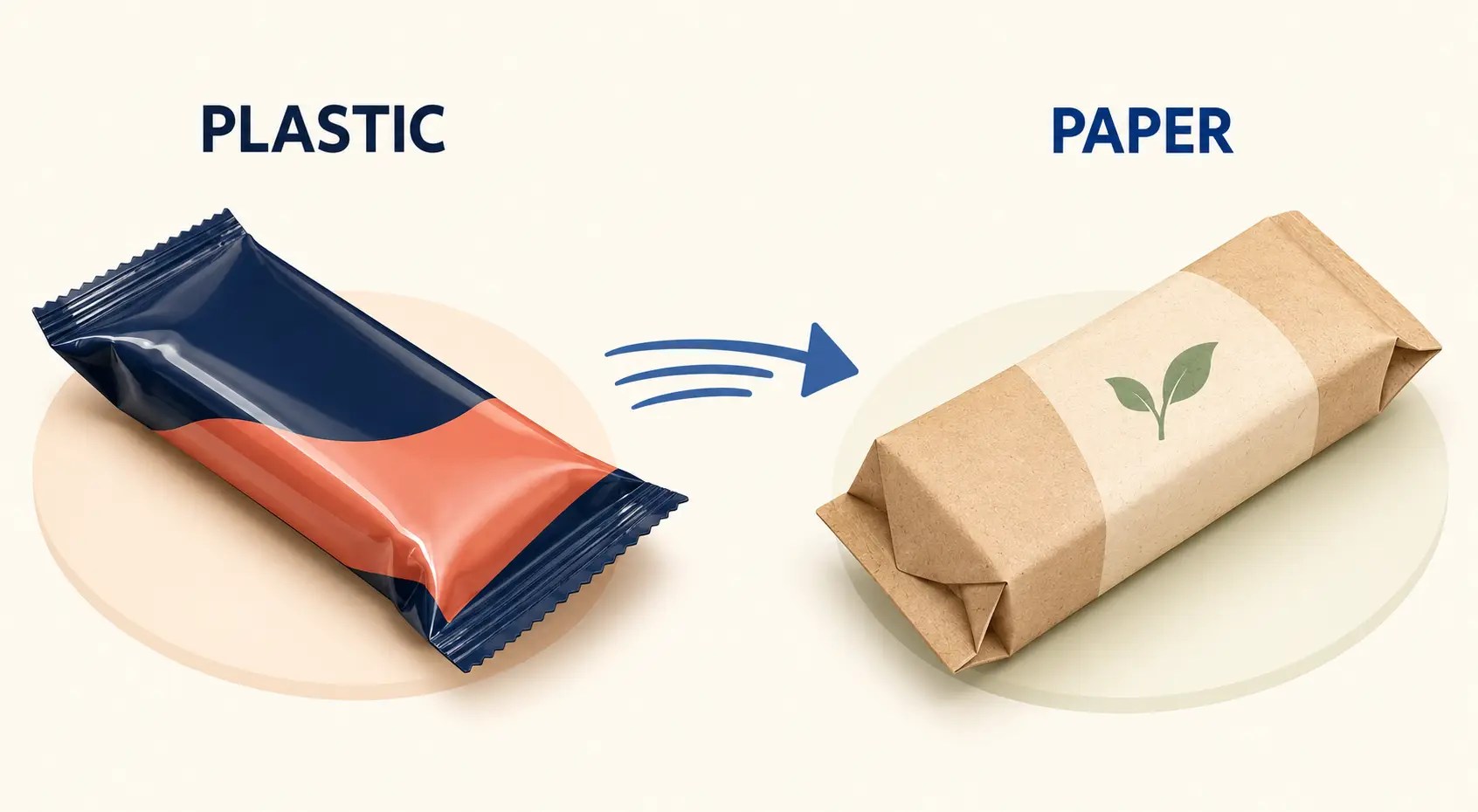
Marks & Spencer: Vanilla Fudge Bar
Marks & Spencer trialed paper-based packaging for its top-selling Vanilla Fudge Bar and has since expanded the format to other products. The switch was driven by consumer demand to reduce plastic packaging, a goal of making the product more easily recycled, and M&S's broader ESG targets.
Projected to remove 1.4 million plastic packaging units over 12 months from the Vanilla Fudge Bar line alone.
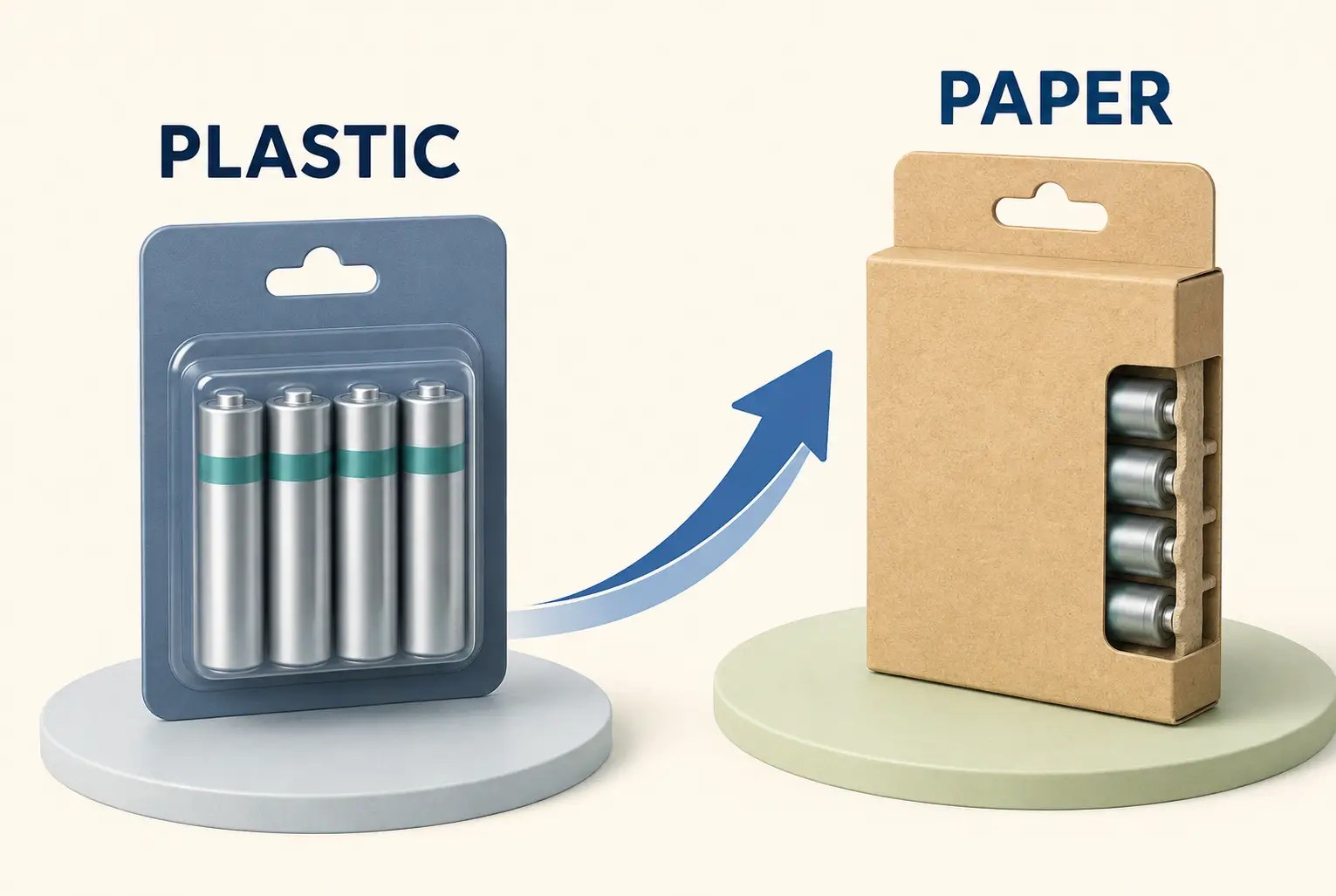
Duracell and Energizer: Battery Blister Packaging
Both Duracell and Energizer moved their battery lines from traditional plastic blister packaging to an all-paper-based solution. The new format is easier for consumers to open without batteries spilling, and is more space-efficient on retail shelves, improving stocking efficiency for retail partners.
Duracell's Walmart rollout alone is projected to reduce packaging waste by 855,000 lbs and reduce CO2 emissions from landfills by 170 metric tons per year.

“Almost on a daily basis I'm seeing examples of either converters or paper producers or even brand owners who are introducing paper-based packaging to replace plastics.
BillerudKorsnäs has announced a line of pouches that are heat sealable and based on paper. Mars has switched to paper-based packaging for some of their candies. KitKat in Australia has actually switched to paper-based packaging.”
How we help
How can Prescouter help?
Moving to paper packaging requires evidence across materials, suppliers, regulation, economics, and production performance. Prescouter brings expert-led research and validation together, helping teams make defensible packaging decisions confidently. The following services can support your brand from early evaluation through supplier engagement and implementation.
Technology and material scouting
Prescouter can map paper materials, barrier coatings, forming technologies, and heat-sealable structures against requirements. Researchers compare performance data, commercial readiness, intellectual property, suppliers, and relevant industry applications systematically. This research helps teams separate technically credible options from materials supported mainly by marketing.
Each candidate can be assessed against moisture, oxygen, grease, sealability, shelf-life, and repulping needs. Comparisons can also account for machinery compatibility, certification, lead times, and available production capacity. Your team receives a ranked view of options suited to specific products and markets.
Supplier and partner vetting
We can identify paper producers, converters, coating suppliers, equipment manufacturers, and recycling partners globally. Candidates are reviewed for technical capability, certifications, quality systems, capacity, pricing, and financial stability. Anonymous outreach can verify claims, secure samples, and clarify commercial terms before formal engagement.
Shortlists give procurement teams clear comparisons, risk indicators, backup options, and recommended next steps. This work reduces dependence on a single supplier while supporting reliable sourcing during scale-up. Prescouter can also facilitate introductions and coordinate early discussions between brands and selected partners.
Expert interviews and technical validation
Prescouter connects teams with packaging engineers, material scientists, converters, recyclers, and regulatory specialists directly. Structured interviews can test assumptions around barriers, machinery, sourcing, recyclability, and market acceptance directly. These conversations can reveal operational details that published reports and supplier brochures frequently omit.
Expert feedback can validate shortlist criteria before your team commits capital or operational resources. Multiple perspectives help identify disagreements, evidence gaps, and risks requiring further investigation before decisions. Prescouter then converts these findings into practical recommendations for packaging and procurement teams to apply.
Regulatory and competitive intelligence
Prescouter can examine EPR rules, plastic restrictions, recycling standards, and labeling requirements across markets. Teams can understand where paper receives favorable treatment and where local infrastructure limits benefits. This intelligence supports market-specific decisions instead of applying one packaging strategy across every region.
Competitive research can compare material choices, supplier relationships, claims, launches, and reported sustainability outcomes. That context helps brands identify category expectations, open opportunities, and technical benchmarks before competitors. It also shows where competitors encountered delays, compromises, or customer resistance during adoption programs.
Business case and implementation planning
Prescouter can compare material premiums, EPR fees, equipment investment, freight, damage, and supplier costs. Technical and commercial evidence can then identify products offering stronger returns with manageable risk. This analysis helps leaders prioritize budgets without assuming every plastic format should become paper.
Findings can be organized into pilots, testing requirements, supplier actions, decision gates, and timelines. Clear milestones help technical, procurement, sustainability, and marketing teams work from shared evidence throughout development. Prescouter can continue supporting validation as your brand advances from evaluation toward commercial rollout.
FAQs
Questions packaging teams ask first
Do barrier coatings affect the recyclability of paper packaging?
Some coatings, adhesives, and liners can make paper packaging harder to repulp or recycle. Brands should test complete packaging structures and confirm acceptance within each target market's recycling system.
What are the latest innovations in eco-friendly paper packaging?
Recent innovations include repulpable barrier coatings, heat-sealable paper structures, molded-fiber alternatives, and flexible paper packaging. These developments improve resistance to moisture, grease, oxygen, and heat while reducing plastic use. AI-driven packaging optimization also helps businesses right-size packages, lower material consumption, and reduce transportation emissions.
How can I choose sustainable paper packaging options for my business?
Begin by assessing your products' protection, shelf-life, moisture, grease, and oxygen-barrier requirements. Compare materials based on responsible sourcing, recycled content, machinery compatibility, package weight, and local recyclability. Testing complete packaging structures, including coatings and adhesives, helps confirm their performance and environmental claims.
What are the benefits of using paper packs over plastic?
Paper packaging can reduce reliance on fossil-based materials while offering renewable and widely recyclable alternatives. It also provides strong printing, structural-design, and branding opportunities alongside familiar disposal instructions for customers. Recyclable paper formats may also receive lower EPR fees than difficult-to-recycle multilayer plastics.
Can paper packaging run on existing production machinery?
Paper may tear, wrinkle, or seal differently from plastic on existing production lines. Machinery trials should assess tension, speed, feeding, folding, sealing temperatures, downtime, and required equipment modifications.
How do EPR regulations affect paper packaging costs?
Extended Producer Responsibility programs may charge lower fees for recyclable paper than difficult-to-recycle plastic packaging. For high-volume products, these savings can help offset paper's material, testing, and conversion costs.
Next step
Find out which SKUs are ready for paper — and which aren't.
Bring us your portfolio, your barrier requirements, and your target markets. We'll come back with a ranked view of formats, suppliers, fee impacts, and the tests each option still has to pass.